



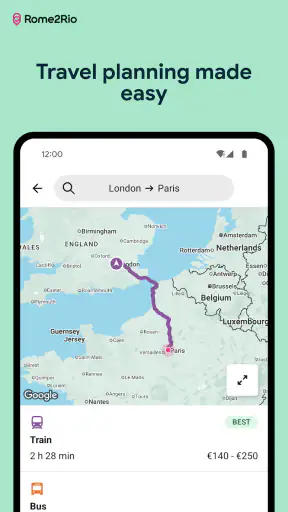
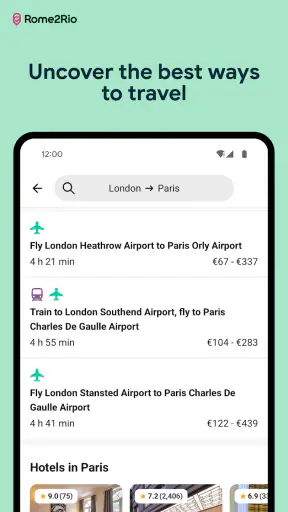
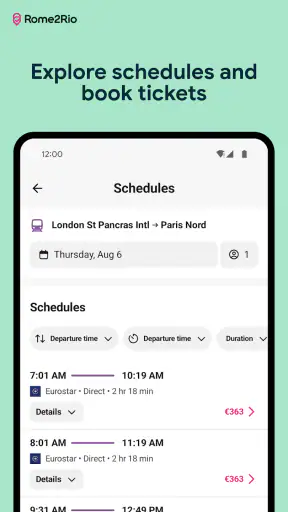
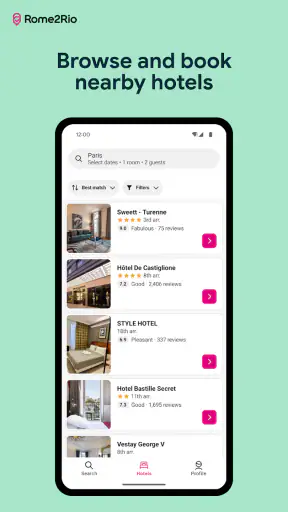
Planning a journey across cities or countries can become complicated as soon as more than one type of transport is involved. A map app may show the driving route, while a train operator covers only its own network and a ferry company hides its timetable elsewhere. I found Rome2Rio useful because it approaches the problem from the whole journey rather than from one transport provider. It helps me think through combinations of trains, buses, ferries, flights, cars and walking in one place, which is especially helpful when I do not yet know the best way to connect two destinations.
Rome2Rio: Travel Route Planner is a free travel and local app from Rome2Rio Pty Ltd. It is available to everyone, and its broad purpose is simple: enter a starting point and a destination, then compare possible ways to get between them. The app has a 4.6 average from around 6,500 ratings and has passed one million installs, so it has clearly found an audience among people who plan independent trips.
My overall impression is positive, but I would not treat it as the final authority for every departure time or fare. I see it as a strong discovery and comparison tool. It is excellent at showing the shape of a journey, revealing connections I might overlook, and helping me decide whether a route is realistic. I still check the relevant transport provider before paying or leaving, particularly when a missed connection would cause a serious problem.
Where route planning usually gets stuck
The first search is easy, but the result needs interpretation
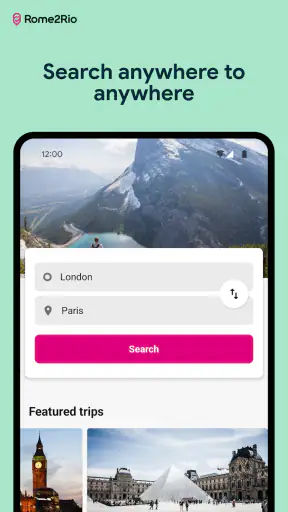
The main search feels approachable: I choose where I am leaving from, where I want to go, and when I intend to travel. The useful part begins after that. Instead of assuming that the fastest-looking option is automatically best, I look at the transport mix, the number of changes, and whether the route depends on a connection that could be awkward in real life.
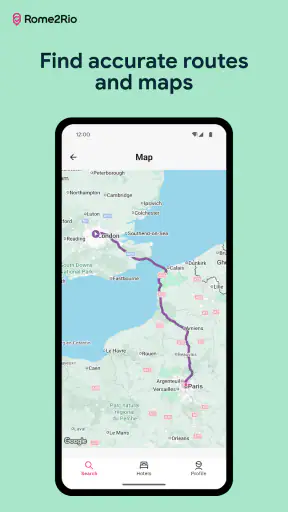
This matters because a journey that looks tidy on a screen can still involve a long walk between stations, a change of terminal, or a transfer from a regional stop into a city centre. Rome2Rio is valuable when it exposes those combinations early. It gives me a starting map of the trip before I spend time opening several separate operator apps.
One common point of friction is the location itself. Searching for a large city is different from searching for a particular station, port or airport. If I use only a city name, the app may present a broad set of options. That is useful for exploration, but it can be less precise when I already know the exact terminal I need. I therefore refine the departure and arrival points whenever the journey includes a major transport hub.
Not every attractive route is equally practical
I pay close attention to the difference between a route that is theoretically possible and one that suits my circumstances. A cheaper combination may require several changes. A faster option may involve an airport far outside the centre. A ferry connection may be appealing on a map but inconvenient if I am carrying luggage or arriving late in the day.
My advice is to use the first results as a shortlist rather than a command. I compare the options according to the things that matter for that particular trip: total travel time, transfers, luggage, arrival location, and how much room there is for delays. This is one of the app’s strengths, but it also means the user has to make the final judgement.
A realistic everyday example
Imagine I am staying outside a city and need to reach a coastal town for a morning appointment. A normal map might make driving appear obvious, while a railway app might show only the train portion. With Rome2Rio, I can examine a combination such as local transport to a central station, a longer rail journey, and a final bus or walk. I can then see whether the last connection leaves me with enough margin.
If the result requires changing from a train to a ferry, I do not stop at the headline duration. I check where the change happens and whether the arrival point is actually close to my destination. That extra step prevents a common planning mistake: choosing a route that is efficient between transport hubs but inconvenient for the final part of the journey.
Setup checks that prevent avoidable confusion
Start with a precise search
Before blaming the app for an odd result, I check the spelling and location suggested for each place. Cities can have similar names, and a destination may be represented by a district, station or nearby settlement. Selecting the intended place is especially important when a route crosses borders or uses a port outside the town that travellers normally name.
I also check the travel date and time rather than assuming the app has understood my plans exactly. A route suitable for a weekday morning may be poor at the weekend, and an evening search can produce a different balance between available services and total journey time. When my schedule is flexible, I test more than one departure period instead of judging the entire network from a single search.
Understand what the app is best at
Rome2Rio works best at the planning stage, when I am asking, “How could I get there?” It is less useful as a replacement for every official booking or live-service tool. Once I have chosen a promising route, I use the transport provider’s own information to confirm the exact departure, ticket conditions and any last-minute change.
This two-step workflow is more reliable than expecting one app to do everything. Rome2Rio helps me discover a route across different transport systems. The operator is usually the better place to complete a purchase or verify a service that is particularly time-sensitive. Use the app to compare the journey, then verify the critical leg before committing.
Check the device and app basics
The application supports Android devices running version 6.0 or later, which covers a wide range of phones. On a compatible device, I would still make sure the app is updated through the normal app store process, especially if a search behaves strangely or the interface does not load as expected. The current version is 2026.08.13, so keeping the installed version current is a sensible first check.
If a result takes a long time to appear, I check the basics before changing my travel plan: whether the phone has a working connection, whether another app can load fresh information, and whether the issue affects one search or every search. I avoid repeatedly changing several settings at once because that makes it harder to identify the real problem.
Prepare for the practical parts of the trip
For a multi-leg journey, I write down the important handoff points after finding a route. I note the departure hub, the arrival hub, the next connection and the final destination. This is not busywork. It makes the route easier to follow when I am tired, offline, or standing in a crowded station where the app is not the only thing competing for my attention.
I also check whether the route involves transport that needs extra preparation, such as a ferry crossing, a long walk, or a change between separate stations. The app can reveal the combination, but I remain responsible for judging whether I can manage it with luggage, children, mobility needs or a tight schedule.
Recovering when a route or search does not behave as expected
When no useful route appears
If the app does not show a sensible option, I first broaden the search slightly. I try the city rather than a small neighbourhood, or a central station rather than an obscure pickup point. This can reveal the larger transport pattern. After that, I narrow the result again by checking the actual first and last mile.
I also try a different date or time to determine whether the problem is the route itself or the selected schedule. If every variation looks poor, that may simply reflect the transport network. A remote destination may genuinely require a car, a long transfer, or a combination that is not convenient. In that situation, changing the search wording will not create a practical service that does not exist.
When a connection looks too tight
I treat short transfer times with caution, even when the route is displayed clearly. Separate tickets, unfamiliar stations, platform changes and delays can turn a neat itinerary into a stressful one. I look for an alternative with fewer changes or a longer buffer, particularly when the next departure is infrequent.
A useful trick is to compare the complete route with a simpler version that ends at a major hub. If the hub-to-destination leg is the risky part, I investigate that section separately. This isolates the weak link and helps me decide whether to change the final transfer, arrive earlier, or use a different mode for the last stretch.
When details appear inconsistent
Transport information can change outside the app’s control. Seasonal schedules, service disruptions, local events and operator updates can all affect what is possible. If a result conflicts with a notice at a station or with the official operator’s current information, I trust the most direct current source for that specific service and adjust the plan.
I do not interpret a mismatch as proof that the entire app is unreliable. Aggregating many transport networks is useful precisely because it gives broad coverage, but broad coverage also means that individual details deserve checking. The more important the journey, the more carefully I verify the final leg.
When the app is not the cause of the problem
Network and location issues can look like route errors
A phone with a weak connection may show incomplete or delayed information, especially while moving between stations or crossing rural areas. If the app suddenly behaves differently, I compare it with another service that needs fresh internet access. I also keep the route details I have already reviewed somewhere accessible rather than depending on a live search at the exact moment of a transfer.
Location accuracy can create similar confusion. If I search from a broad area or rely on an automatically detected position, the suggested starting point may not be the place I had in mind. I prefer entering the known station, stop or address when precision matters. This is particularly important at airports and ports, where several nearby points can have very different transport options.
Human assumptions are often the weak link
Sometimes the route is correct but my interpretation is not. I may assume that two stations share a building, that a bus departs from the railway platform, or that a city-centre arrival is close to my accommodation. I now read the route as a sequence of physical movements rather than a line on a map.
That means checking the first walk, every transfer, and the final approach. For a traveller with a suitcase, a ten-minute connection is not equivalent to a ten-minute connection for someone travelling light. For a family, a route with fewer changes may be worth more than a modest saving in time or money. Rome2Rio helps me compare these choices, but it cannot know my comfort level unless I apply it myself.
When another tool is the better choice
If I already know I will use one railway network, the operator’s own app may be better for live platform information, ticket management and service alerts. For a purely urban journey, a local transit app can offer more detailed stop-by-stop guidance. For driving, a dedicated navigation tool is usually more appropriate for traffic, turn-by-turn directions and parking.
Rome2Rio earns its place between those tools. It is most valuable when the journey crosses transport modes or providers and I need to understand the overall structure. I would skip it for a simple local trip that I can plan more accurately through the city’s own transport system. I would also avoid relying on it alone when a missed connection could cause a major financial or personal problem.
What I would use it for, and what I would not
Best uses for independent travellers
I would recommend the app to someone who is building an itinerary from scratch, comparing a train with a bus, or trying to connect places that are not served by one obvious operator. It is also useful when visiting an unfamiliar country because it gives me a broad first view instead of forcing me to know the local transport companies in advance.
It can help with route budgeting too, although I treat displayed costs as planning guidance and confirm the final amount before purchase. The more valuable benefit is often not choosing the absolute cheapest option. It is discovering that a slightly different departure point, transport mode or connection makes the whole day easier.
Three habits that make the app more useful
- Search the whole journey first, then inspect the riskiest transfer separately. This reveals whether the problem is the main route or only the final connection.
- Compare a fast option with a low-change option. The difference shows whether the time saving is worth extra complexity, walking or dependence on a tight connection.
- Save or record the key handoff points in your own trip notes. A route is easier to follow when you can see the next station or port without rebuilding the entire search.
These habits also answer a practical question many new users have: do I need to understand every transport system before using the app? No. I can begin with broad place names, learn the likely route, and then refine the search once I understand the geography. The app is most approachable when I use it as a conversation with the journey: start broad, identify the weak point, and investigate that part.
Who should look elsewhere
I would not make this my only planning tool if I need detailed live navigation inside one city, guaranteed real-time operational control, or a complete ticket wallet for a specific operator. It is also not the ideal answer for someone who wants a single tap from their current position to a nearby destination. Its value grows with the complexity of the trip.
Travellers who dislike comparing alternatives may find the range of routes more work than expected. The app can reduce research time, but it does not remove the decisions. I prefer that balance because it lets me choose according to luggage, timing and comfort, but users wanting a fully automatic answer may prefer a narrower local service.
My practical verdict after using Rome2Rio
Rome2Rio is a thoughtful travel and local planning app that solves a real problem: connecting transport systems that are usually presented separately. I like it most before booking, when I need to understand whether a journey is possible and what compromises each option involves. The free price makes it easy to keep available for exploratory planning, and the Everyone age rating makes it suitable for general household use.
Its main limitation is also tied to its purpose. A broad route planner cannot replace the final checks required for a particular train, bus or ferry. I still verify critical times, ticket details and service changes with the relevant provider. I also allow more breathing room than the neatest suggested itinerary may imply.
For a realistic trip, my workflow is straightforward: search the complete route, refine the locations, compare the number of changes, inspect the most vulnerable transfer, and confirm the final service before departure. If the app produces an unexpected result, I test the place names, date, time and connection before assuming something is broken. If another source disagrees, I investigate the specific leg rather than discarding the whole plan.
That makes Rome2Rio: Travel Route Planner a strong companion for multi-city and multi-modal travel, particularly for people who want to explore possibilities without opening a dozen operator websites. I would recommend it to a friend who is still shaping a journey. I would not tell that friend to follow every result blindly. Used as a route-discovery and comparison layer, it saves effort and often reveals options I would otherwise miss; used as the sole authority for a high-stakes departure, it needs support from official transport information.


